
You have a website, you publish content regularly, but you remain invisible on Google. You type in your main keywords and see that your competitors occupy the entire first page while your site languishes on page 3, 5, or worse. Does this situation sound familiar? You’re not alone. With over 1.8 billion websites online, the battle for visibility is fiercer than ever.
But here’s the good news: reaching Google’s first page isn’t a matter of luck or a colossal marketing budget. It’s a matter of method. And this method, applied rigorously, can bear fruit in 90 days. Not in a week, not in a month, but in three months of structured and intelligent work.
Why 90 days? Because it’s the realistic timeframe for Google to analyze your improvements, reassess your site, and start trusting you. It’s also the time needed to build solid foundations without taking risky shortcuts that could penalize you.
In this article, I’ll guide you through a three-phase action plan:
- Phase 1 (Days 1-30): Technical audit and laying foundations
- Phase 2 (Days 31-60): Content creation and optimization
- Phase 3 (Days 61-90): Building your online authority
Each phase is essential. Skipping a step is like building a house without foundations. So, ready to transform your online presence? Let’s go.
Phase 1: Days 1 to 30 – Audit and Technical Foundations
Technical Cleanup: The Invisible but Essential Basics
Before thinking about content or backlinks, your site must be technically flawless. Google has become demanding, and a slow or poorly configured site will never take off.
Loading Speed and Core Web Vitals
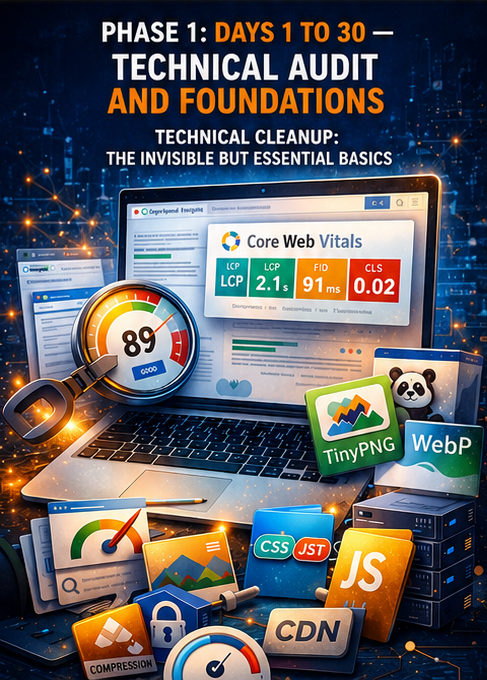
Google uses Core Web Vitals to measure user experience. These three metrics are now official ranking criteria:
- LCP (Largest Contentful Paint): The loading time of the main content (ideally under 2.5 seconds)
- FID (First Input Delay): The delay before the page responds to interactions (less than 100 milliseconds)
- CLS (Cumulative Layout Shift): The visual stability of the page during loading (score below 0.1)
To measure these indicators, use Google’s PageSpeed Insights. This free tool will give you a complete diagnosis and precise recommendations.
Concrete actions to take:
- Compress your images with tools like TinyPNG or Squoosh
- Enable browser caching
- Minimize unused CSS and JavaScript
- Switch to WebP format for your images
- Consider a CDN (Content Delivery Network) if you have an international audience
Indexing and Accessibility
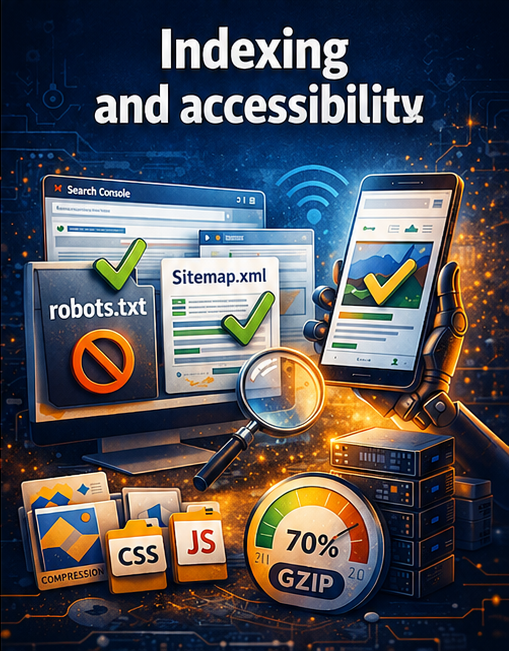
A site invisible to Google is a site that doesn’t exist. Verify that your robots.txt file doesn’t accidentally block important pages and that your XML sitemap is correctly submitted in Google Search Console.
Mobile Compatibility
With over 60% of searches performed on mobile, your site must be perfectly responsive. Use Google’s mobile optimization test to identify issues and fix them immediately.
Enable GZIP compression on your server. This simple manipulation can reduce your file size by 70% and improve your loading speed in minutes.
Strategic Keyword Research: Aim Right to Win Fast
The biggest mistake for SEO beginners? Targeting keywords that are too competitive. If you’re a new site wanting to rank for “car insurance” or “marketing training,” you’re going to hit a wall.
The Long-Tail Strategy
Long-tail keywords are expressions of 3 to 5 words, more specific and less competitive. They represent approximately 70% of Google searches and have a higher conversion rate because the search intent is more precise.
Example: Instead of targeting “running shoes,” aim for “best running shoes for beginners 2025” or “waterproof women’s trail running shoes“.
How to find your long-tail keywords:
- Use Google Suggest by typing your main keyword and noting the suggestions
- Check the “People Also Ask” section in search results
- Explore AnswerThePublic to discover real user questions
- Analyze keywords with Ubersuggest, SEMrush, or Ahrefs (free versions available)
Selection criteria:
- Monthly search volume: 100 to 1000 searches (this is plenty to start)
- Difficulty: Less than 30 out of 100
- Commercial intent: Prioritize informational keywords to build your authority
Create an Excel list with 20 long-tail keywords in your niche. For each, note the search volume and difficulty. Prioritize the 5 easiest to target and plan an article for each.
Competitor Analysis: Learn from Those Who Succeed

Your competitors on the first page have something you don’t have yet. Your mission: understand what and how to replicate it better.
Top 10 Analysis:
For each of your target keywords, analyze the top 10 Google results:
- What’s the average article length? (Count the words)
- What type of content do they use? (Complete guide, list, case study, video)
- What subheadings structure their content?
- What media do they integrate? (Images, infographics, videos, tables)
- How many backlinks do they have? (Use Ahrefs or Moz)
Content Gap Analysis:
Look for what your competitors HAVEN’T covered. An original angle, an unanswered question, a missing recent update. This is your opportunity to create something better.
Take your main keyword and create a comparison table of the top 5 Google results. Note the length, structure, strengths and weaknesses. You now have the blueprint to create superior content.
Phase 2: Days 31 to 60 – Content and On-Page Optimization
The Golden Rule of Content: Perfectly Answer Search Intent
The best SEO content isn’t the one with the most keywords. It’s the one that best answers the user’s question.
Understanding Search Intent
There are four types of intent:
- Informational: The user wants to learn (“how to make homemade bread”)
- Navigational: They’re looking for a specific site (“Facebook login”)
- Transactional: They want to buy (“buy iPhone 15 Pro”)
- Commercial: They’re comparing before buying (“best CRM for SMBs”)
Analyze the current Google results for your keyword. The type of content on the first page indicates the dominant intent.
The Formula for Converting Content:
- Engaging introduction: Identify the problem in 2-3 sentences
- Clear promise: Say what the reader will learn
- Structured body: Use clear subheadings (H2, H3) every 300 words maximum
- Concrete examples: Illustrate each point with practical cases
- Actionable conclusion: Give the next steps
Optimal Length:
Studies show that first-page articles average 1500 to 2500 words. But this isn’t an absolute rule. Some topics require 500 words, others 5000. The important thing is to be thorough without being wordy.
Quick Win: Before writing, create a detailed outline with all your H2 and H3 headings. This structures your thinking and ensures you cover all aspects of the topic. Bonus: it’s exactly what Google likes to see.
Semantic Optimization: The Details That Make the Difference
Once your content is created, technical optimization will multiply its ranking potential.
Title Tag (SEO title):
This is the first element that Google and users see. Your title must:
- Contain your main keyword (ideally at the beginning)
- Be between 50 and 60 characters
- Create desire to click with a clear benefit
Example: “SEO in 90 Days: The Complete Plan to Reach Google’s Page 1”
Hn Tags (hierarchical structure):
- H1: Only one per page, contains the main keyword
- H2: Main sections (3 to 7 per article)
- H3: Subsections to detail H2s
This structure helps Google understand your content architecture and improves user experience.
Meta-description:
Although it doesn’t directly influence ranking, it impacts click-through rate (CTR). A good meta-description:
- Is 150 to 160 characters
- Contains the main keyword
- Encourages action with a benefit
Example: “Discover the proven method to propel your site to Google’s first page in 90 days. Detailed action plan, step by step.”
Internal Linking:
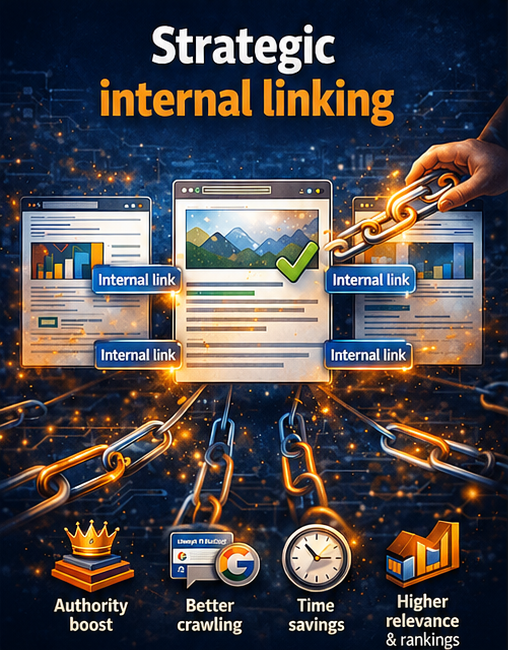
Liez vos arink your articles together strategically. Each new article should contain 3 to 5 links to other pages on your site. This:
- Distributes authority from page to page
- Improves Google’s crawling
- Increases time spent on your site
- Reduces bounce rate
Quick Win: Go back to your last 10 articles and add 3 relevant internal links in each. In 30 minutes, you create a network of links that boosts your entire site.
Updating Existing Content: Give Your Old Content a Second Life
You already have articles on your site? Perfect. Updating them is often more effective than creating new ones.
Identifying Content to Refresh:
In Google Search Console, spot pages that:
- Are in positions 8 to 20 (just below the first page)
- Have a good number of impressions but low CTR
- Cover topics that are still relevant
Update Process:
- Update obsolete statistics and data
- Add 300 to 500 words of new content
- Improve titles and subheadings for more clarity
- Integrate new visuals or infographics
- Optimize the meta-description and title
- Add internal links to your new content
- Modify the publication date
The Freshness Signal:
Google values regularly updated content. By modifying an old article, you give it an immediate boost in search results.
Quick Win: Identify your best-ranked article (between positions 5 and 15). Add 500 words of relevant content, update two statistics, and improve the title. Observe its evolution in the following 15 days.
Phase 3: Days 61 to 90 – Authority and External Signals
Backlink Strategy: Quality Before Quantity
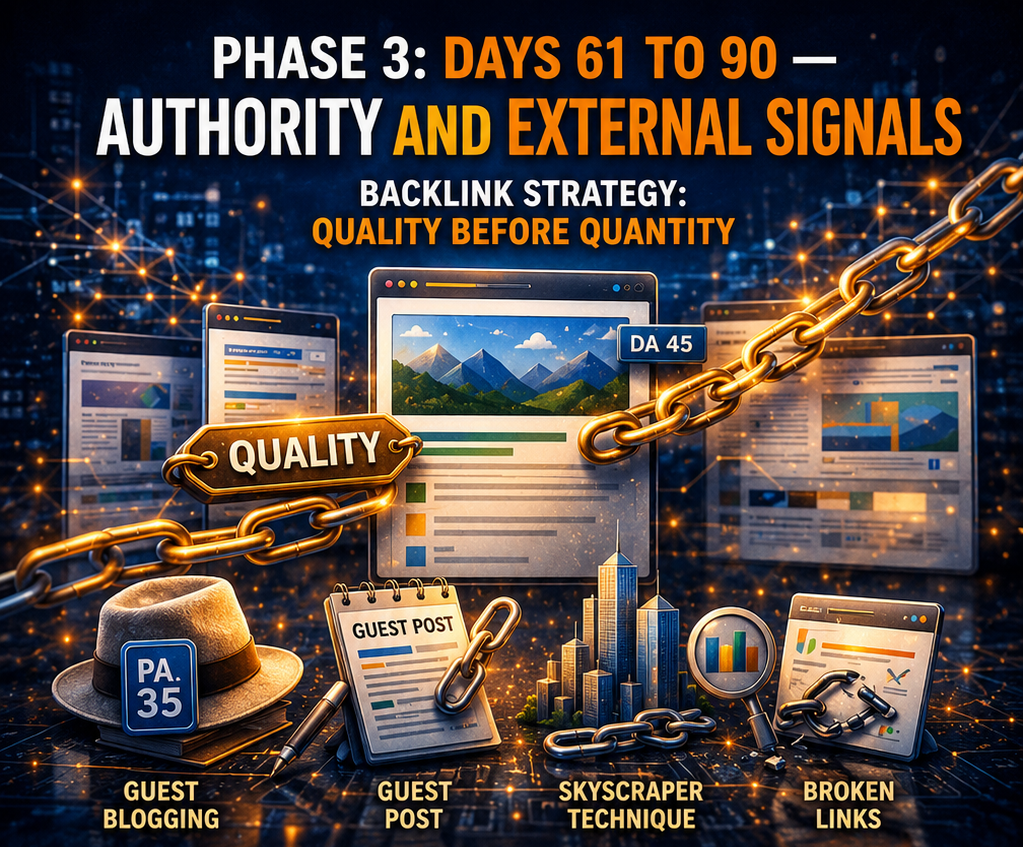
Les backlinks (liens provenant d’autres sites vers le vôtre) restent l’un des trois facteurs de classement les plus importants selon Backlinks (links from other sites to yours) remain one of the three most important ranking factors according to Google. But beware: a bad backlink can do more harm than good.
What is a Quality Backlink?
- Comes from a site in your niche or a related niche
- Comes from a site with good domain authority (DA above 30)
- Is placed in editorial content, not in footer or sidebar
- Uses natural anchor text and varied
- Is dofollow (passes “SEO juice”)
White-hat Techniques to Obtain Backlinks:
Guest blogging: Offer to write a quality article for a blog in your sector in exchange for a link to your site. Focus on the value provided, not on the link.
Skyscraper Technique: Find popular content in your niche with many backlinks. Create a 10x better version and contact sites that linked to the original to suggest your improved version.
Broken Link Recovery: Use tools like Ahrefs to find broken links on sites in your niche. Contact webmasters to report the dead link and propose your content as a replacement.
Creating Linkable Resources: Infographics, case studies, original statistics, free tools. This type of content naturally attracts backlinks.
Digital Press Relations: Contact journalists or bloggers who write about your topic via platforms like HARO (Help A Reporter Out).
What to Absolutely Avoid:
- Mass link buying
- Private blog networks (PBN)
- Excessive link exchanges
- Low-quality directories
- Blog comment spam
Quick Win: Create an infographic with 5 key statistics from your sector. Publish it on your site, then contact 10 blogs in your niche to share it. Even with a 20% success rate, you get 2 quality backlinks.
Social Signals and E-E-A-T: Demonstrating Your Credibility
E-E-A-T stands for Experience, Expertise, Authoritativeness, Trustworthiness. It’s the framework Google uses to evaluate content quality, particularly in YMYL (Your Money Your Life) domains like health, finance, or legal.

How to Strengthen Your E-E-A-T:
Experience: Show that you have real experience with the topic. Include case studies, examples from your practice, screenshots of results obtained.
Expertise: Create a detailed “About” page presenting your qualifications, degrees, years of experience. Add an author bio at the bottom of each article with a professional photo.
Authoritativeness: Get mentions in recognized media, publish guest articles on authority sites, participate in conferences or podcasts in your sector.
Trustworthiness: Add legal pages (legal notices, privacy policy), display authentic customer reviews, cite your sources with links, use HTTPS.
Social Signals:
Although Google states that social signals (likes, shares) are not a direct ranking factor, they indirectly influence your SEO:
- They generate traffic to your site
- They increase the visibility of your content (more chances of getting backlinks)
- They strengthen your brand and perceived authority
Concrete Actions:
- Share each new article on your professional social networks
- Create visual excerpts (quotes, statistics) for LinkedIn and Twitter
- Participate in Facebook or LinkedIn groups in your niche
- Engage in authentic conversations, don’t just promote your content
Quick Win: Create or optimize your LinkedIn profile with a solid professional summary. Post once a week sharing an insight from your latest article. Social traffic boosts your engagement metrics, a positive signal for Google.
Performance Tracking: Measure to Progress
Without measurement, no improvement. The last 30 days of your SEO plan should also serve to establish a tracking routine.
Google Search Console: Your Main Dashboard
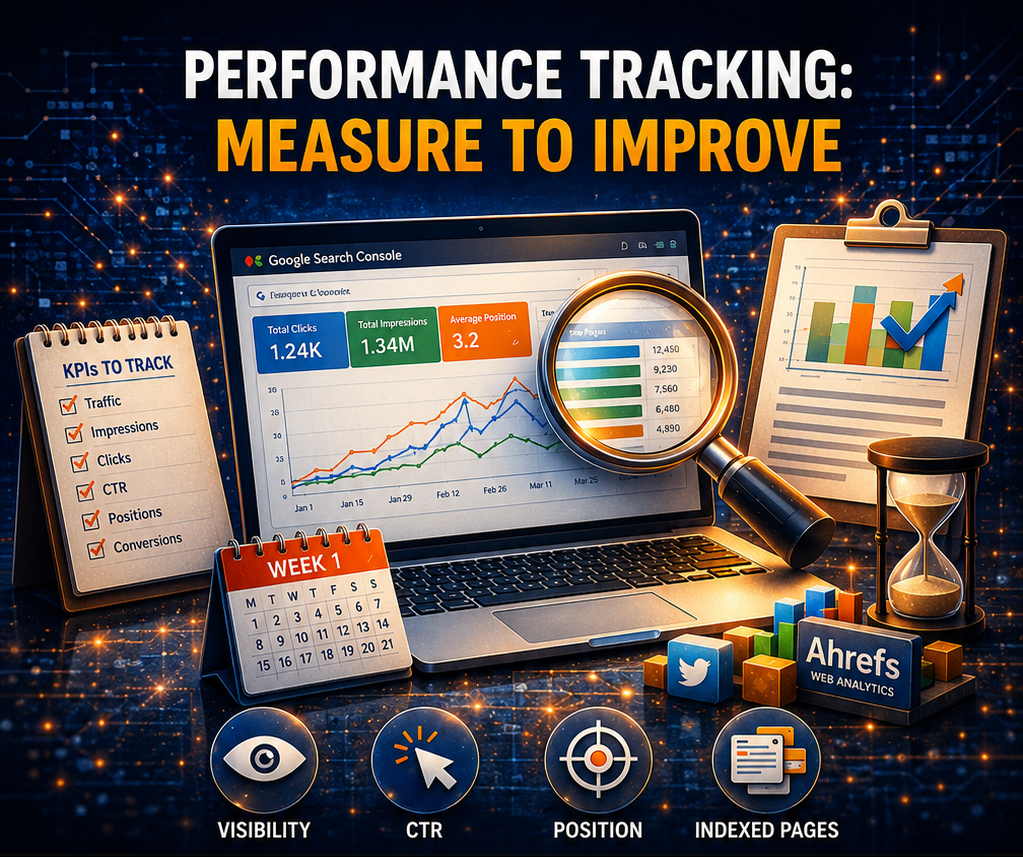
This free tool shows you:
- Which keywords generate impressions and clicks
- Your average position for each query
- The pages that perform best
- Crawl errors and indexing issues
For a good start with this essential tool, check out the official Google Search Console guide which explains how to configure and effectively use all features.
Metrics to Monitor Weekly:
- Number of impressions (visibility)
- Average click-through rate (CTR)
- Average position (ranking evolution)
- Indexed pages
Google Analytics: Understanding User Behavior
Analytics reveals what happens once the user arrives on your site:
- Page views and sessions
- Bounce rate
- Average time on page
- User journey
Key Metrics to Analyze:
- If your bounce rate exceeds 70%, your content may not match search intent
- If average time on page is less than 1 minute for a 1500-word article, your content isn’t engaging enough
- If pages per session are low (less than 2), improve your internal linking
Complementary Tools:
- Ahrefs or SEMrush: To track your backlinks, analyze competition, and discover new keywords
- Screaming Frog: To audit technical aspects (404 errors, redirects, missing tags)
- Hotjar or Crazy Egg: To visualize how users interact with your pages (heatmaps, recordings)
Create Your Tracking Routine:
- Weekly: Check Search Console for new positions and technical issues
- Bi-weekly: Analyze traffic in Analytics and adjust underperforming content
- Monthly: Complete backlink audit, update your content strategy
Quick Win: Create a simple Google Sheets file with 5 columns: Date, Impressions, Clicks, Average Position, Notes. Fill it every Monday morning with Search Console data. In 3 months, you’ll have a clear vision of your progress.
Conclusion
SEO isn’t magic. It’s not a sprint either. It’s a marathon where consistency beats sporadic intensity.
By following this 90-day plan, you’ve laid solid foundations:
- A technically optimized site that offers an impeccable user experience
- Quality content that precisely answers your audience’s questions
- Growing authority through relevant backlinks and strengthened E-E-A-T
- Tracking tools to measure your progress and adjust your strategy
But here’s the truth nobody tells you: day 90 isn’t a finish line, it’s the beginning of a new stage.
The Post-90 Days Mindset
At the end of these three months, you’ll likely see your first pages climbing to Google’s first page. Some long-tail keywords may already be in the top 3. This is encouraging, but it’s only the beginning.
SEO is a long-term investment. The sites that dominate search results are those that:
- Publish quality content consistently (at least 2-4 articles per month)
- Update their old content every quarter
- Continue to develop their backlink network naturally
- Stay aware of Google algorithm updates
- Listen to their audience and adapt their strategy
Your Next Step
Now that you have the roadmap, it’s time to take action. But I understand that all this can seem intimidating. That’s why I created two resources to support you:
A complete checklist, week by week, with all the tasks to accomplish. Print it, check off each completed action, and stay on track.
🔍 Request your free SEO audit
Send me your site URL and I’ll send you a personalized 15-minute video audit pointing out the 3 priority actions for your specific situation.
Natural search is one of the rare marketing channels where your efforts today continue to generate results for months, even years. Every optimized article, every quality backlink, every technical improvement is an asset that works for you 24/7.
So, ready to transform your site into an organic traffic machine? The next 90 days are going to pass anyway. Might as well use them to build something that matters.
Your turn to play




0 Comments